BREAKING DOWN BARRIERS TO AI

Updated: Sep 2

A recent story by Business Insider's Aki Ito, Executives are Coming to Terms with AI's Slow Impact on Work, tells a frustrating story. Three years after the debut of ChatGPT, AI’s impact on productivity has been 'meh,' according to 15 chief people officers and other senior executives Ito met with in Davos. She noted that 84% of work processes haven’t been redesigned for AI, and only 16% of organizations are re-thinking work in an AI‑native way.
So, what's the holdup? New barriers have arisen that add business requirements and complexity, which traditional strategies have difficulty overcoming. The barriers these executives named mostly related to incomplete employee adoption, as workers worry about job impacts or doubt the usefulness of AI tools.
We get it. AI isn’t just a tool problem. It’s an adoption, skills, workflow, data, and governance problem. How do you start breaking down barriers like these? One brick at a time.
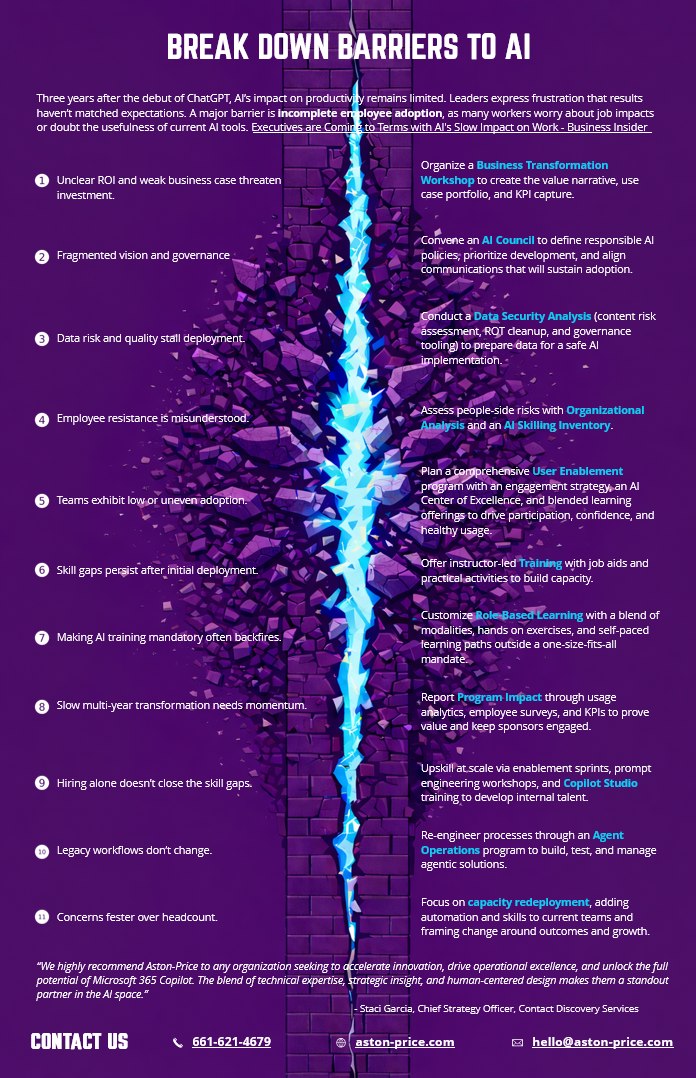
We took the barriers mentioned in Ito's article and mapped each to a strategic solution. Our proprietary framework combines AI advisory to develop strategy and planning with user enablement programs for execution. The result is the infographic linked below. It lists the top tactics to translate ideas into effective, measurable, and lasting change in a secure, responsible, and paced manner. Let us know if you find it helpful.


Comments